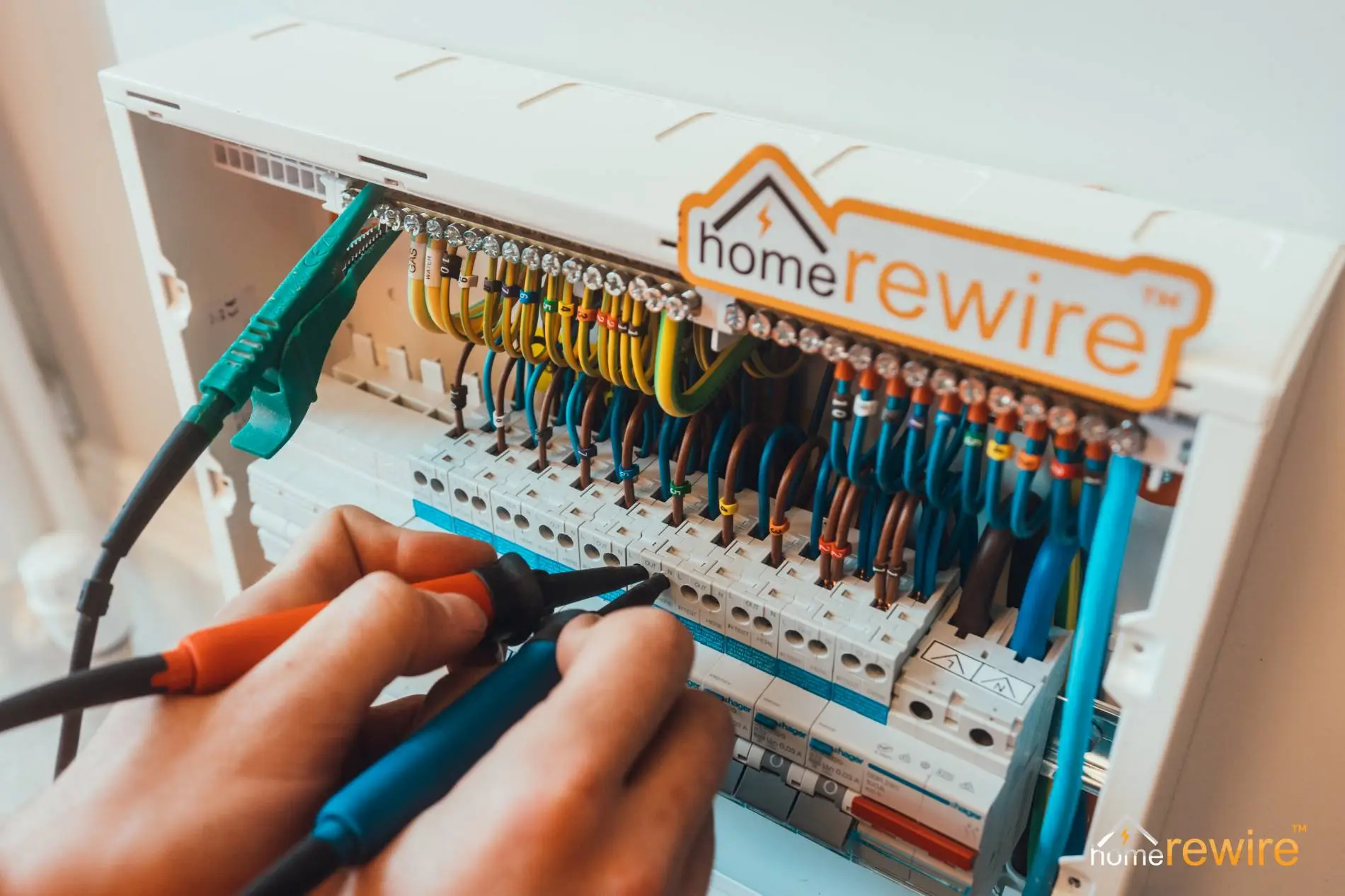
Whether you’ve just bought a property, you’re a landlord trying to stay compliant, or you’ve had an electrician mention your “old fuse board,” this fuse box vs circuit breaker guide cuts through the confusion.
Fuse Box vs Circuit Breaker: Side-by-Side
Here’s how the two stack up across the things that actually matter.
| Feature | Fuse Box (Old Style) | Modern Consumer Unit (Circuit Breakers) |
| Overcurrent protection | Yes — fuse melts | Yes — MCB trips |
| Reusable after fault | No — fuse must be replaced | Yes — simply reset |
| RCD/shock protection | Rarely | Standard in modern units |
| Reset time after trip | Minutes to hours (sourcing fuse) | Seconds |
| Meets current BS 7671 | Unlikely | Yes |
| Suitable for landlords | May fail compliance checks | Yes |
| Fire risk | Higher with age/damage | Lower |
| Tamper risk | Higher (wrong fuse wire used) | Lower |
What Is a Fuse Box?
A fuse box, properly called a fuse board or consumer unit is the older type of electrical distribution panel. It controls and protects the circuits in your home using fuses: small wire or ceramic components that physically melt and break the circuit when too much current flows through them.
Once a fuse blows, it’s done. You have to replace it before that circuit works again. In older properties, you’ll often find rewirable fuses, little ceramic cartridges you’d stuff with fuse wire. Before that became impractical enough for people to ignore it entirely, anyway.
Most fuse boxes found in UK homes today are at least 25–30 years old. Some go back to the 1960s and 70s. That’s not automatically a safety problem, but it does mean they were designed for a fraction of the electrical load a modern household puts through its wiring.
What Is a Circuit Breaker?
A circuit breaker does the same core job, protecting your circuits from overload, but instead of burning out, it trips. A small switch mechanism detects excess current and flips to the off position. Reset it, and you’re back in business.
Modern consumer units use miniature circuit breakers (MCBs) for each circuit, and residual current devices (RCDs) or a combined RCBO to add an extra layer of protection against electric shock. That last part is the big one. Old-style fuses don’t protect people, they protect wiring. RCDs protect you.
Why the Difference Actually Matters
Here’s where it stops being a terminology question and becomes a practical one.
Old fuse boxes weren’t designed for dishwashers, EV chargers, underfloor heating, or homes running multiple high-draw appliances simultaneously. When something goes wrong, a fault, an overload, they respond slowly or not at all.
And when someone bodges a fuse with the wrong wire rating, the protection disappears entirely without anyone noticing.
Modern circuit breakers trip fast, reset instantly, and in the case of RCDs, can detect a fault current as small as 30 milliamps, enough to save a life. That’s not marketing language. That’s physics.
What About Split-Load Consumer Units?
Most homes upgraded in the 1990s or early 2000s will have a split-load board, a consumer unit with some RCD protection but not full coverage. Better than a fuse box, but not the same as a fully-protected modern unit with RCBOs on every circuit. If you’re unsure what you’ve got, that’s worth checking.
What Does Your Property Actually Have?
If you can safely look at your consumer unit (don’t touch anything, just look), here’s a rough guide:
- Wooden back panel or ceramic fuse carriers — original fuse board, likely pre-1970s
- Grey or cream plastic board with wire fuses — 1970s–1980s vintage
- Plastic board with small switches (MCBs) but no RCD — possibly early 1990s
- Plastic board with MCBs and at least one large RCD switch — split-load, 1990s–2000s
- White or grey board with individual RCBOs per circuit — modern, fully protected
Honestly, if you can’t tell, or you’re looking at something that looks like it belongs in a museum — book an EICR and get a professional view.
Does a New Consumer Unit Mean You Need a Rewire in Scotland?
Not necessarily, but often the two go hand in hand.
If your wiring is old enough to have a fuse box, it might also be old enough to have rubber-insulated cables, no earth bonding, or circuits that don’t comply with current regulations. Fitting a modern consumer unit onto wiring that’s failing is a bit like putting a new front door on a house with rotting walls.
The electrician carrying out the work has a duty to inspect what they’re connecting to.
A full EICR will flag whether the wiring itself needs attention. Sometimes a consumer unit replacement is all that’s needed. Other times, the bigger job is unavoidable.
How HomeRewire Can Help
If any of this has made you wonder about your own property’s electrics, HomeRewire are worth a conversation. As Glasgow’s house rewiring specialist, we’ve completed over 6,000 rewires, and unlike most contractors, we typically finish a full house rewire in just 1–2 days.
It comes from running larger coordinated crews and having done this more times than most firms will manage in a lifetime.
All work is certified to BS 7671, with consumer unit replacement, EICR testing, and optional plastering and cleaning add-ons available.
Request your free rewire quote.
Frequently Asked Questions
Is a fuse box illegal in the UK?
No — having one isn’t illegal. But if you’re renting a property out, an outdated fuse board may show up as a C2 (potentially dangerous) or even C1 (danger present) issue on an EICR, which would need rectifying before the property is compliant.
Can I replace a fuse box myself?
No. Consumer unit replacement is notifiable work under Part P of the Building Regulations in England and Wales, and equivalent rules apply in Scotland. It must be carried out by a registered electrician who can certify the work.
What does it cost to replace a fuse box in Scotland?
A straightforward consumer unit replacement typically runs £300–£600 depending on the number of circuits and property size. If rewiring is needed as well, costs vary significantly — getting a quote is the only reliable way to know.
How long does a consumer unit replacement take?
Usually half a day to a full day. The electrics will be off for most of that time.
What’s an RCBO and do I need one?
An RCBO combines the functions of an MCB and an RCD in a single device. It protects both against overcurrent and earth faults on a per-circuit basis. Modern best practice is to fit one per circuit — it means a fault on one ring doesn’t knock out half your house.
My lights keep tripping the RCD — is that a wiring problem?
Possibly. Nuisance tripping can be caused by faulty appliances, ageing wiring with degraded insulation, or moisture in fittings. An EICR will usually identify the source. Don’t just keep resetting it and hoping for the best.
Does an old fuse box affect my home insurance?
Some insurers ask about the age and type of consumer unit, and a very old fuse board can affect your premiums or complicate a claim after an electrical fire. Worth checking your policy wording.