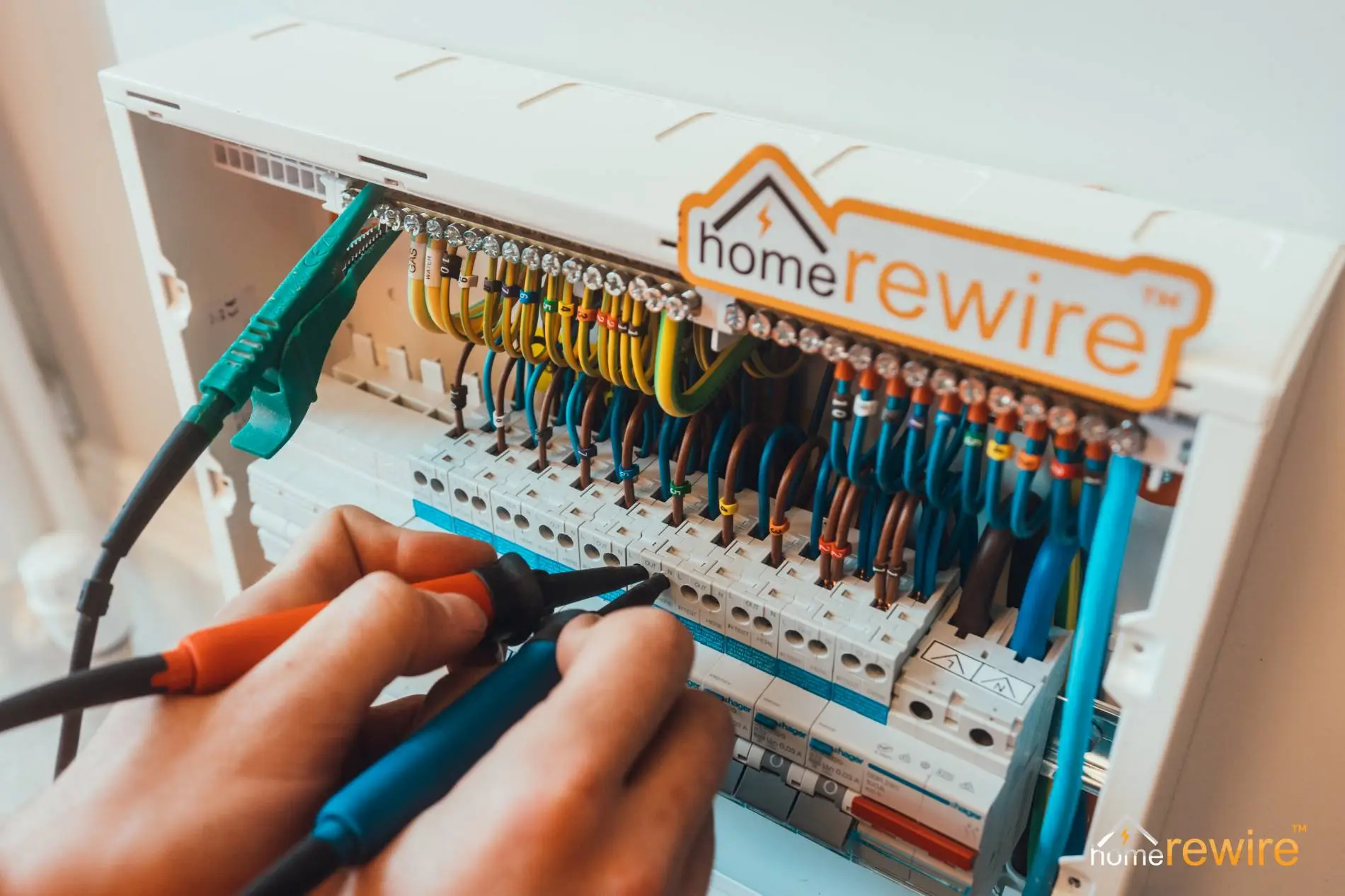
Rewiring a house means removing old, unsafe cables and replacing them with new wiring, sockets, switches, and a modern consumer unit. It is a regulated, high-risk job that must be done by a qualified electrician. DIY rewiring is not safe and is not legal for major electrical work.
How is a house rewired? The work is carried out in two main stages: first fix (removing old cables, chasing walls, routing new wiring) and second fix (connecting sockets, switches, lights, testing, and certification). A rewire also includes a new consumer unit with modern safety protection.
At HomeRewire in Glasgow, this is the standard process our team follows for every rewire across Scotland. We combine clear step-by-step work with expert compliance to meet Scottish Building Standards and BS 7671.
1. House Rewire Planning and site assessment
Before work starts, our electrician will inspect the property and assess the existing system.
The assessment includes:
- Checking the condition of cables, the consumer unit, and all circuits.
- Mapping out where new sockets, switches, lights, and appliance points should go.
- Deciding on circuit layouts and load capacity.
- Identifying any special requirements such as extra lighting, EV charging, or appliance circuits.
Good planning at this stage prevents problems later. It helps decide where furniture sits, where appliances go, and whether extra points are needed for daily use.
2. Rewire First fix: removing old wiring and installing new cables
First fix is the structural part of the rewire. Old wiring is removed and new cables are installed to the current Scottish Building Standards and BS 7671. House rewiring services in Glasgow ensure that your home is safe and up to code. They provide comprehensive inspections and updates to all electrical systems, enhancing both safety and efficiency. Engaging professionals in this field can also increase your property’s value and sustainability.
At HomeRewire, every first fix is carried out with full attention to compliance and safety.
Chasing walls
Channels are cut into solid walls to install back boxes for sockets and switches and to route cables. The channels are made to the correct depth and width for the cable type.
Cutting holes in plasterboard
In drywall areas, holes are cut to install back boxes without damaging large sections of wall. This keeps the work more controlled and reduces repair time later.
Lifting floorboards
Floorboards are lifted to route cables underneath floors. Cables are secured to joists and protected where needed to prevent damage.
Running cables through walls, floors, and ceilings
New cables are pulled through the building structure and secured to framing. Cables are routed safely and kept away from points where they could be damaged.
Securing cables
Cables are clipped or fixed in place so they do not move, sag, or become damaged during construction work.
Consumer unit installation
The old fuse box is replaced with a modern consumer unit. This includes safety devices such as RCDs and MCBs that protect against electric shock and faults.
At HomeRewire, we ensure the consumer unit is installed correctly, labelled, and ready for full testing.
At this stage, the house looks worse before it looks better. Walls are open, floorboards are up, and there is dust. This is normal. First fix is about getting the infrastructure in place.
3. Making good
After first fix, walls and ceilings need repair. This process is known as making good.
Making good includes:
- Filling chased channels in walls.
- Replacing damaged plaster or plasterboard.
- Tidying up around back boxes and cable routes.
- Preparing surfaces for painting.
At HomeRewire, we can handle making good ourselves or coordinate a plasterer or decorator. We manage this so the job finishes smoothly and the property is left in good condition.
4. Second fix: connecting devices
Once the wiring is in and walls are repaired, the job moves to second fix. This is where the visible parts of the installation are completed.
Fitting faceplates
Sockets and switches are connected and covered with faceplates. They are secured tightly and aligned for a clean finish.
Connecting lights
Lighting fittings are installed, wired up, and checked. Care is taken to ensure safe termination and correct operation.
Installing accessories
Any extra points, USB sockets, or special accessories are installed. These are wired and tested like any other part of the system.
At HomeRewire, our second fix is carried out with full attention to safety and compliance. Every connection is checked and verified.
At this stage, the installation looks complete and the house feels like a home again.
5. Testing and expert compliance certification
Once everything is connected, the system is thoroughly tested. This is not optional. At HomeRewire, expert compliance is built into every stage of the work.
Testing includes:
- Continuity checks.
- Earth fault loop impedance testing.
- RCD trip testing.
- Polarity checks.
- Insulation resistance tests.
- Functional testing of all circuits.
Once the system passes, we issue an Electrical Installation Certificate (EIC). This proves the work is compliant with Scottish Building Standards and BS 7671. Finding the best electricians in Glasgow can greatly influence the quality of your electrical installations. These professionals are well-versed in the local regulations and safety standards, ensuring that your project meets all necessary requirements. Utilizing expert services not only enhances safety but also provides peace of mind during the installation process.
Our compliance process ensures every rewire meets the correct legal and technical requirements. This gives homeowners, landlords, and future buyers clear proof that the work is safe and properly completed.
Technical work during first fix
First fix is the most involved part of a rewire. It includes the core electrical installation work.
Typical tasks include:
- Removing old cables completely.
- Routing new cables through the building.
- Protecting cables where they pass through walls or floors.
- Installing back boxes for sockets and switches.
- Creating circuit layouts and testing at each stage.
- Installing the consumer unit and terminating circuits.
At HomeRewire, we follow this process consistently, with full attention to compliance and safety.
Technical work during second fix
Second fix focuses on finishing the installation and making it functional.
Typical tasks include:
- Fixing and wiring faceplates.
- Connecting and checking lights.
- Verifying all circuits for correct operation.
- Commissioning the consumer unit.
- Performing final safety tests.
At HomeRewire, second fix is completed to the same standard as first fix, with full testing and certification. First fix electrical work overview involves the installation of crucial wiring and components before walls are closed up. This stage is essential for ensuring that all electrical systems are set up safely and efficiently. After completing this phase, the focus shifts to finalizing fixtures and ensuring everything meets regulatory standards.
Do you need a new consumer unit?
Yes. A rewire always includes replacing the old fuse box with a modern consumer unit.
Old fuse boxes do not offer the same protection as modern consumer units. A new unit includes safety devices like RCDs that protect against electric shock and faults. It makes the whole system safer and easier to manage.
At HomeRewire, we always include a new consumer unit as part of a full rewire.
What cables are used in a rewire?
Standard domestic cables that meet current safety requirements are used in rewires.
Typical cable types include:
- Twin and earth cable for sockets and lighting circuits.
- SWA (steel wire armoured) for special circuits or external work.
- Flexible cable for lighting connections.
The exact cable type depends on the circuit and the location. At HomeRewire, we select the correct cable for each job.
How long does rewiring a house take?
How long a rewire takes depends on:
- Size of the property.
- Condition of existing wiring.
- Amount of remedial work required.
A small property might take a few days. A larger house could take a week or more.
At HomeRewire, we plan rewires in stages to keep disruption as low as possible while maintaining full compliance.
Will a rewire disrupt your home?
Yes. A rewire is disruptive by nature. Dust, noise, and temporary loss of power in parts of the house can occur while the work is being done.
At HomeRewire, we manage this by:
- Agreeing on access needs before work starts.
- Planning for some rooms to be out of use temporarily.
- Expecting noise and dust during first fix.
- Arranging for making good to be completed after the wiring is done.
Good planning helps reduce frustration and keeps the job moving smoothly.
What questions should you ask before a rewire?
Before committing to a rewire, it is helpful to ask:
What is included in the quote?
Make sure sockets, switches, consumer unit, and making good are all covered.
Will the consumer unit be replaced?
Yes – a rewire should include a new consumer unit. At HomeRewire, this is standard.
Who is handling making good?
Clarify whether HomeRewire, a plasterer, or a decorator will do the repairs.
What certification will be issued?
You should receive an Electrical Installation Certificate (EIC) that proves the work is compliant. At HomeRewire, we issue full certification on every rewire.
How much access will be needed each day?
Agree on this upfront so expectations are clear.
What certification do you get after a rewire?
After a rewire, the electrician tests the system and issues an Electrical Installation Certificate (EIC).
At HomeRewire, we provide this certification on every rewire. The EIC proves:
- The work was done to the correct safety standard.
- The system has been tested and is safe.
- The property is compliant with Scottish regulations and BS 7671.
This paperwork is important for homeowners, landlords, and future buyers.
Why does rewiring matter?
Rewiring is one of the biggest upgrades a house can have. It improves safety, reliability, and compliance. For older homes in Glasgow and Scotland, it removes a hidden risk and gives a system that can handle modern electrical demand. Rewiring costs for older homes can be a significant investment, but the benefits often outweigh the expenses. Many homeowners find that the long-term savings on energy bills and the increased home value justify the initial outlay. Additionally, updated wiring can lead to a more efficient and enjoyable living environment. Electricity costs for home rewiring can vary significantly based on the home’s size and the complexity of the electrical system. Homeowners should consider obtaining multiple quotes to ensure they receive a fair price for the work. Investing in high-quality materials and skilled labor can ultimately lead to better performance and lower energy costs in the long run.
At HomeRewire, a rewire is not just about replacing cable. It is about creating a safer, smarter, and more dependable electrical system for the whole home, with expert compliance built into every stage.
If a property is old, unsafe, or struggling to cope with modern life, rewiring is often the best long-term solution.