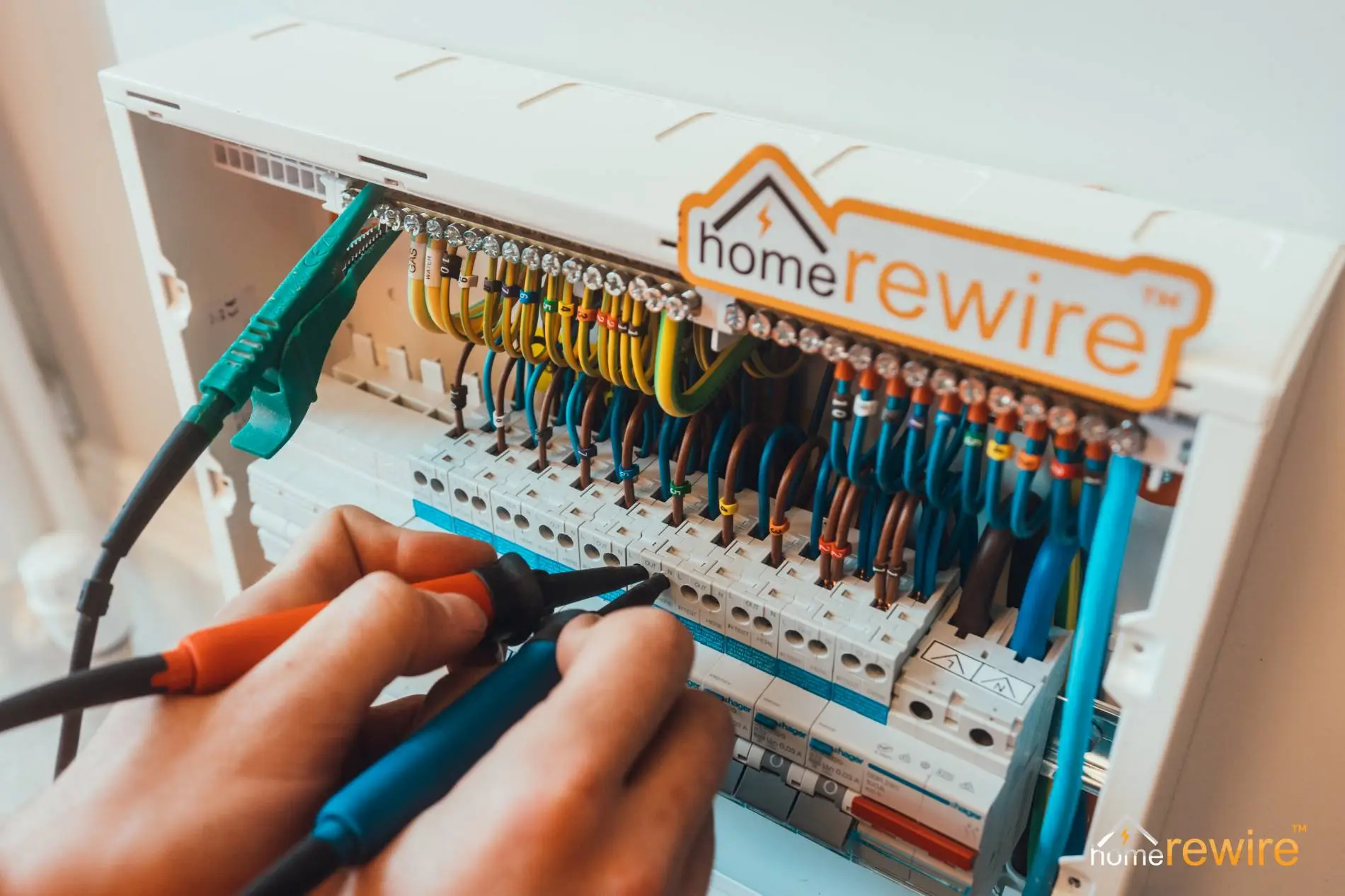
An EICR — Electrical Installation Condition Report — is now a legal requirement across most tenancy types, and failure to hold a valid one can result in penalties of up to £30,000. It’s not optional, and it’s not something to deal with only when a tenant complains.
Here at HomeRewire, we have Scotland’s best electricians on hand to help and advise our hard working residents. Our expert guide covers everything landlords need to know, broken down clearly by tenancy type, location, and cost.
What Is a Landlord Electrical Safety Certificate?
An EICR is a formal inspection of a rental property’s fixed electrical installation by a highly qualified electrician — covering wiring, socket-outlets, light fittings, fuse boxes, and earthing arrangements. It must be carried out by a qualified and competent electrician for safety reasons. The outcome is either satisfactory or unsatisfactory, with faults coded by severity:
- C1 — Immediate danger, requires urgent action
- C2 — Potentially dangerous, remedial work required
- FI — Further investigation needed
Any C1, C2, or FI result means the certificate is unsatisfactory. Landlords must complete all remedial works within 28 days of receiving the report — or sooner if the report specifies. If unsure, speak to us today to get a clearer picture of what you need to do next.
Landlord EICR Legal Requirements in England
All private rented properties in England must hold a valid EICR under the Electrical Safety Standards in the Private Rented Sector Regulations 2020. As of November 2025, this obligation was extended to cover the social rented sector too — so social housing landlords are now bound by the same rules.
Key landlord obligations under English law:
- Mandatory electrical inspection every five years
- New tenants must receive a copy of the EICR before moving in
- Existing tenants must receive a copy within 28 days of a new inspection
- Local authorities can request the report — landlords must provide it within 7 days
- Non-compliance penalties reach up to £30,000
Landlord Electrical Safety Requirements in Scotland
Scotland introduced mandatory EICR requirements for landlords ahead of England, and the rules are embedded in the Repairing Standard. Private landlords must hold a valid EICR as a condition of their landlord registration — without it, your registration isn’t valid and you can’t legally let the property.
A copy of the certificate must be provided to tenants at the start of the tenancy and within 28 days of any new report. Councils can issue Repairing Standard Enforcement Orders against non-compliant landlords, and in serious cases rent can be withheld entirely.
If you own rental property in Glasgow or anywhere across central Scotland, an up-to-date EICR isn’t a nice-to-have — it’s a condition of doing business as a landlord.
How Often Do Landlords Need an EICR?
| Tenancy Type | Legal Requirement | Frequency |
|---|---|---|
| Private rental — England | Mandatory | Every 5 years |
| Private rental — Scotland | Mandatory | Every 5 years |
| Social housing (UK) | Mandatory from Nov 2025 | Every 5 years |
| HMO licence properties | Mandatory | Every 3–5 years |
| Short-term lets — Scotland | Effectively mandatory | Every 5 years |
| Commercial landlords | Best practice / insurer requirement | Every 5 years |
How Much Does a Landlord EICR Cost?
| Property Type | Typical Cost |
|---|---|
| Flat / apartment | £100–£230 |
| 3–4 bedroom house | £150–£300+ |
| Large detached / 5+ bed | £300+ |
| HMO (3–4 bedrooms) | £150–£250 |
| HMO (5–6 bedrooms) | £250–£350 |
| HMO (7+ bedrooms) | £350–£500+ |
| Minor Works Certificate | From £60 |
Electrical safety certificate costs vary by location and contractor. Glasgow and central Scotland pricing may differ.
HMO Landlord Electrical Requirements
HMO landlords face stricter obligations than standard private landlords. Because multiple unrelated tenants share the building, local councils apply tighter licensing conditions — and the electrical installation is scrutinised closely at every licence renewal.
Most HMO licences require an EICR every five years, but many local authorities — including Glasgow City Council — ask for one every three years or at every licence renewal, whichever is sooner.
Fire alarm systems, emergency lighting, and bonding arrangements in bathrooms and kitchens are also assessed as separate requirements. An unsatisfactory EICR can hold up a licence renewal or, in serious cases, result in the property being taken out of use until remedial works are complete.
What Happens When a Landlord EICR Fails?
An unsatisfactory EICR doesn’t mean the end of the world — but it does mean a 28-day clock starts ticking. For minor issues like a faulty socket or an earthing problem, the fix is usually straightforward.
For older properties — particularly pre-1970s tenements common across Glasgow and Edinburgh — a failed EICR often points to wiring that’s genuinely past its useful life. In those cases, a full house rewire is the only proper resolution.
That’s a situation we deal with regularly at HomeRewire. Because we complete full house rewires in 1–2 days rather than the 4–10 days most electricians quote, landlords working against a 28-day remedial deadline aren’t left scrambling.
We’ve handled this across thousands of properties throughout Scotland and can typically get a quote turned around fast when there’s urgency involved.
Short-Term Let Landlords in Scotland
Scotland’s short-term let licensing scheme, introduced in 2023, requires properties to meet safety standards that make a current EICR effectively unavoidable.
Most insurers covering Airbnb-style lets will also require one before issuing a policy. If you’re operating in the short-term let market in Scotland without a valid certificate, it’s worth addressing that before your next booking rather than after a problem arises.
Landlord EICR — Frequently Asked Questions
What is the penalty for a landlord without a valid EICR?
In England, local authorities can impose financial penalties of up to £30,000. In Scotland, non-compliance with the Repairing Standard can result in enforcement orders and rent being withheld by tenants. Neither outcome is worth the risk.
Does a new fuse board satisfy a failed EICR?
Sometimes — if the main fault identified was an outdated consumer unit. But it won’t resolve deteriorated wiring or widespread C2 issues elsewhere in the property. If the installation is in poor condition throughout, a full rewire is usually required alongside any consumer unit upgrade.
Can a landlord carry out their own EICR?
No. The inspection must be completed by a qualified and competent person — typically registered with NICEIC or SELECT in Scotland. An unqualified inspection carries no legal standing and won’t satisfy a local authority request.
Do landlords need both an EICR and a PAT test?
An EICR covers the fixed electrical installation. A PAT test covers portable appliances — kettles, lamps, white goods. For furnished rentals, both are advisable, but only the EICR is a statutory landlord requirement.
How quickly can HomeRewire help a landlord with a failed EICR?
We can inspect and, where a rewire is required, complete the full job within 1–2 days across Scotland. We work regularly with landlords and letting agents on tight remedial timescales and will give you a straight answer on cost and availability from the first conversation. Get in touch to discuss your property.